BUENOS AIRES - ARGENTINIEN


Wenn man direkt von Rio de Janeiro nach Buenos Aires kommt, ist man in der Versuchung, ständig beide Städte zu vergleichen. Aber ich will mich hier auf drei Aspekte beschränken und später nur noch über Buenos Aires sprechen, eine grandiose Stadt, die das wirklich verdient hat. Erstens: Rio ist im Vergleich zu Buenos Aires dreidimensional durch die steilen Hügel und die Klippen, um die herum die Stadt gewachsen ist und denen sie sich anpassen musste. Buenos Aires dagegen liegt in einer
Ebene und konnte sich großzügig nach allen Seiten ausbreiten, konnte unglaublich breite Straßen und Boulevards kerzengerade durch die Stadt führen lassen und hatte genügend Fläche für weite Parklandschaften. Zweitens: beide Städte sind durch die europäisch beeinflusste Kolonialarchitektur geprägt, aber in Rio gibt es einen sichtbaren Einfluss von
afrikanischer Kultur, der in Buenos Aires fast völlig fehlt. Buenos Aires erinnerte uns an Paris oder vielleicht noch mehr an Madrid. Drittens: für Rio de Janeiro spielt das Meer eine wichtige Rolle, die Stadt öffnet sich zu Meer und die phantastischen Strände sind der Höhepunkt vieler Stadtteile. Buenos Aires dagegen wendet dem Rio de la Plata den Rücken zu und will nicht wirklich etwas davon wissen. Das drückte sich sogar in unseren jeweiligen Liegeplätzen aus. In Rio lag das Schiff an einem Pier mit einladenden Gebäuden und einem schönen Blick auf die
Stadt und wir wurden mit lauter Musik begrüßt. In Buenos Aires lagen wir im Containerhafen und mussten eine Weile mit dem Shuttlebus fahren, um erst einmal zur Einschiffungshalle zu gelangen.

Aber jetzt konzentrieren wir uns ganz auf Buenos Aires. Wir verbrachten zwei Tage dort. Am ersten nahmen wir an einer geführten Tour teil. Zuerst besuchten wir das historische Zentrum und machten am Plaza Mayo halt. Auf der einen Seite befindet sich die Casa Rosada, Sitz des Präsidenten, auf der anderen Seite das alte Rathaus Cabildo und die Kathedrale.
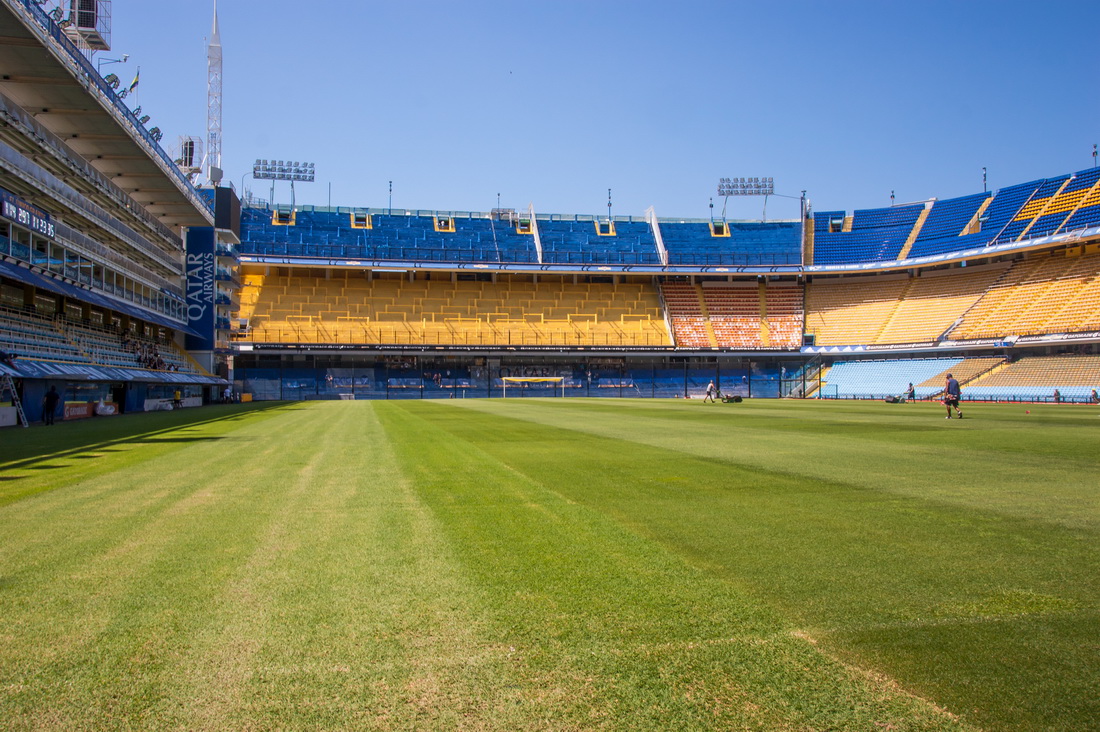
Wir fuhren durch den historischen Stadtteil San Telmo und am Theater Colon vorbei, einer der besten Opernhäuser der Welt. Aber unser eigentliches Ziel was der Stadtteil La Boca, und dort das Stadium der Boca Juniors, einer von zwei rivalisierenden Spitzenmannschaften in Buenos Aires (der andere ist River Plate). Die Farben des Vereins sind Blau und Gelb (und das hat nichts mit Ikea zu tun, obwohl es viele Theorien über die Farben gibt). Diese Farben findet man im ganzen Stadtviertel wieder. La Boca war das Ziel vieler armen Einwanderer aus Italien, die ihre ersten Behausungen aus Wellblech
und Holz bauten. Heute noch sieht man viele Gebäude dieser Art. Teile des Viertels sind wie ein Open-Air-Museum oder eine Kunstgalerie und wie alle Besucher schlenderten auch wir die Caminito herunter. Und überall ist der Tango.

Am zweiten Tag holte uns Michaels Bekannter aus seiner Industriezeit zusammen mit seiner Partnerin an der Einschiffungshalle ab und machten mit uns eine wunderbare Tour durch die Teile von Buenos Aires, die wir noch nicht gesehen
hatten. Wir haben in diesen Stunden so
viel gesehen und über das Leben in Buenos Aires gelernt, dass ich Bände füllen könnte. Deshalb hier nur eine schnelle Auflistung von den wichtigsten Orten, an denen wir vorbei kamen: Puerto Madres neue Calatrava-Brücke, der Friedhof Recoleta, der Stadtteil Palermo, der Obelisk, der Palacio Barolo, der National Kongress, verschiedene Museen, viele Parks und Grünflächen und so viel mehr. Wir fühlten uns sehr geehrt, dass sie uns in ihr schönes Haus einluden, wir aßen in einem Restaurant am Wasser wunderbar zu Mittag und schließlich gelangten wir noch in den zauberhaftesten
Buchladen der Welt, El Ateneo Grand Splendid. Das war einmal ein Theater und Kino und ist heute der Traum jedes Bücherlesers.

An vielen Orten in Buenos Aires fanden wir Spuren der Erinnerung an die Diktatur in den späten 70ern (Videla und andere). Auf dem Plaza Mayo befinden sich Farbsymbole, die an die „Mütter von Plaza Mayo“ erinnern. Es gibt zahlreiche Plaketten und Denkmäler diese dunkle Zeit betreffend, aber was uns wirklich betroffen machte, war, als wir an einer Stelle aus dem Auto stiegen und auf dem Gehsteig eine eingelassene Platte mit Namen sahen, und unsere Begleiterin uns erzählte, dass dies die Schule war, in die sie gegangen ist, und dass das die Namen von Lehrern und Klassenkameraden sind, die in dieser Zeit „verschwunden“ sind. Siezeigte uns die Namen von mehreren ihrer Freundinnen, die noch nicht einmal erwachsen waren, als sie ermordet wurden.

Am Abend nahmen wir Abschied von Buenos Aires in der Hoffnung hier noch einmal herkommen zu können. Übernacht brachte uns das Schiff nah Uruguay auf die andere Seite des Rio de la Plata und nach Montevideo, über das ich Euch im nächsten Kapitel erzählen werde. 

----------


It was difficult, coming from Rio de
Janeiro, not to permanently compare the two cities. So I try to limit the comparison on three features and afterwards will only tell you about Buenos Aires, which really deserves her own chapter. First, while Rio is three-dimensional with all those steep hills and cliffs within the city and so had to enfold around those natural obstacles, Buenos Aires is on a plain and could spread generously, has wide boulevards, great green spaces and vistas along main traffic arteries. Second: while both cities in their buildings have strong links to European architecture, in Rio’s culture there is a strong African influence, whichyou do not find in Buenos Aires. Buenos Aires reminded us of Paris and even stronger of Madrid. Third: while Rio adores the sea and opens up to wonderful beaches everywhere, Buenos Aires turns her back to the La Plata River and just is not interested. This even showed in the places we docked. In Rio we were at a pier near the city, from where we could see famous landmarks and where greeted with loud music, in Buenos Aires we docked in a
container port and had to be shuttled by bus to an embarkation terminal.

But now let us concentrate on Buenos Aires. We spent two days there. On the first day we went on a guided tour which brought us to the main parts of the inner city, like Plaza Mayo with the Casa Rosada on one side and Cabildo Colonial Town Hall and the Metropolitan Cathedral on the other side, we passed through San Telmo, an old part of the city, and by the Theatre Colon, one of the best opera houses in the world. But our main aim was the district of the city which is called La Boca and there to the stadium of Boca Juniors, which we visited. This is one of two rival clubs of Buenos Aires (the other is River Plate), their colours are blue and yellow (sorry Ikea, lots of theories where this comes from), and those bright colours spread to the whole part of town. La Boca was one part of the city where poor emigrants from Italy first settled down and their built their houses of corrugated iron and wood. And still today one can see many of those structures there. Some part of the quarter is like an open-air-museum or art gallery and we strolled down lanes like Caminito, a must for every visitor. And the Tango is everywhere.

On the second day a former business acquaintance of Michael together with his partner met us at the Embarkation Terminal and gave us the most wonderful private tour to parts of Buenos Aires we had not visited the day before. We saw so much and learnt so much about the city and how people live there that it would fill many pages to tell you all. Here is a quick list of places we passed by: Puerto Madre’s new Bridge by Calatrava, Recoleta Cemetery, parts of Palermo, the Obelisk, Palacio Barolo, National Congress, different museums, different parks and gardens and much more. We felt very honoured that we were invited into their house, we enjoyed a wonderful lunch in a restaurant on the shores of the river and we managed to visit the famous book shop El Ateneo Grand Splendid, which used to be a theatre and a cinema and now has been turned into what is a reader’s paradise.

What impressed us very much in Buenos Aires were the many reminders of the crimes of the dictatorship in the 70th  (Videla and others). On Plaza Mayo there is street art to honour the Mothers of Plaza Mayo, there are lots of remembrance plaques and statues all around the place, but what really disturbed us was when we parked the car in front of the school our lovely guide went to. There on the pavement was a list of teachers and students which have “vanished” during those years and our guide went to school with some which were not even adults when they were murdered by the regime.

In the evening we left Buenos Aires and thought we would be happy if we ever could come back. Overnight the ship brought us to Uruguay on the other side of the Rio de la Plata and to Montevideo, which I will tell you about in the next chapter.
 

RIO DE JANEIRO - BRASILIEN


Was fällt mir dazu ein? Das, was vielleicht jeder sagt: Diese Stadt ist absolut phantastisch. In Salvador de Bahia fanden wir den Gegensatz zwischen Arm und Reich geradezu
bedrückend. In Rio existieren dieselben krassen Unterschiede, aber Rio lächelt und tanzt, und man kann sich dem kaum entziehen. Schon vom Pier aus, an dem unser Schiff lag, entdeckten wir die berühmte Statue von Christus, dem Erlöser, während wir mit lauter Musik empfangen wurden, die uns Tag und Nacht begleitete.

In den zwei Tagen, die wir hier verbracht haben, haben wir versucht, so viel wie möglich von der Stadt kennen zu lernen. Zuerst ging es mit der Gondel hinauf zum Zuckerhut, von wo man einen unglaublichen Blick auf die verschiedenen Stadteile hat. Wir besuchten die Catedral Metropolitana, eine gigantische moderne Pyramide, die bis zu 20 000 Gläubige aufnehmen kann. Wir standen vor den Toren des Maracanã –Stadiums, des größten Fußballstadions der Welt, in dem Deutschland die Weltmeisterschaft 2014 gewonnen hat (was die deutsche Mannschaft hinterher geleistet hat, verschweigen wir besser).

In das berühmte Sambodromo konnten wir nur von außen einen Blick werfen. Hier konkurrieren während des Karnevals die Samba Schulen um einen Platz in der ersten oder der zweiten Liga (ganz wie beim Fußball).  In vier Nächten im Februar präsentieren sich Nacht für Nacht jeweils sieben Gruppen auf der ca. 800 Meter langen Straße, links und rechts mit Zuschauertribünen gesäumt, die extra für dieses Gelegenheit gebaut wurde, damit die Zuschauer Eintritt zahlen müssen und die Stadt dadurch Einnahmen hat. Es gibt 14 Schulen in der zweiten und 14 Schulen in der ersten Liga. Ein Team der zweiten
Liga steigt auf, ein Team der ersten Liga steigt ab. Und es ist ein harter Kampf. Die Samba-Schulen bekommen ein Thema gestellt und haben dann ein Jahr Zeit, passende Musik, Tänzer und Kostüme vorzubereiten. Für ihre Vorführung haben sie nur eine bestimmte Zeit, um den ganzen Weg der 800 Meter zurückzulegen. Brauchen sie zu lange, setzt es Punkteabzug. Es ist wirklich ein ernsthafter Wettbewerb; und da wir nahe der Karnevalszeit sind, laufen die Vorbereitungen auf Hochtouren.
 

Wir fuhren an den Stränden von Copacabana und Ipanema entlang und beobachteten diejenigen Cariocas (so nennen sich die Leute in Rio) mit etwas Neid, die es sich am Strand und in der Sonne gut gehen lassen konnten. Sie und wir hatten Glück mit dem Wetter, denn in den Tagen vor unserer Ankunft hatte es heftig geregnet, und als wir gestern Abend abfuhren, ballten sich schon wieder graue Wolken zusammen.

Was uns an der Stadt besonders beeindruckt hat, war die Mischung verschiedener Architekturstile und Häuserformen. In den Geschäftsvierteln stehen, wie überall auf der Welt die internationalen Banken und Unternehmen in ihren modernen Glaspalästen, aber ein paar Blocks weiter trifft man schon wieder auf kleine, alte Häuschen mit kleinen Vorgärten, einige liebevoll restauriert und bunt angemalt, andere, die noch auf eine Renovierung warten. Aber man hat uns erzählt, dass es jetzt ein neues Gesetz gibt, dass den Hausbesitzern, die ihre Fassade renovieren, Haussteuer für ein paar Jahre erlässt. Vielleicht hilft’s ja.


Was wir überall sehen konnten, war, dass Häuser auf Straßenhöhe und manchmal bis zum zweiten Stock mit Stacheldraht, Gittern oder ähnlichem geschützt werden. Unzweifelhaft gibt es in Rio eine Menge Armut und so ist Kriminalität auch ein großes Problem. Ein Führer sagte uns, dass die Drogenbosse Eigentumskriminalität in den Favelas verhindern, weil das ihre Geschäfte stören könnte. Und so müssen die ganzen Taschendiebe und Kleinkriminellen in die Stadt und an die Strände kommen, um sich ihren Lebensunterhalt zu verdienen.

Offiziell gibt es keine Favelas mehr, und es werden große Anstrengungen unternommen, diese in normale Stadtteile zu entwickeln. Es werden Zufahrtsstraßen gebaut oder Trambahnlinien und die Wohnviertel werden an die Wasser- und Elektrizitätsversorgung angeschlossen. Aber wo immer sich Häuser an einem Steilhang, der eigentlich unbebaubar ist, übereinander türmen, hat man es ganz sicher mit einer Favela zu tun.


Gestern Abend haben wir Rio de Janeiro verlassen. Wir saßen noch lange auf unserem Balkon und sahen die Stadt in der Dämmerung verschwinden und die Lichter von Copacabana und später von Ipanema winkten zu uns herüber, während wir in die Dunkelheit fuhren.
Jetzt haben wir wieder zwei Seetage vor uns, bis wir Buenos Aires erreichen, wo wir einen
ehemaligen Kollegen von Michael treffen werden, aus seiner Zeit in der Industrie, wo er auf Geschäftsreise nach Argentinien geschickt wurde. Wir freuen uns auf eine etwas persönlichere Einführung in diese Stadt.
Zwischen Rio und Buenos Aires liegen 1880 km auf See.


----------


What can I say? What millions said before: Rio de Janeiro is just amazing! Coming from Salvador de Bahia we found the same extreme contrast between rich and poor, but while in Salvador this felt a bit sad or even depressing, in Rio it comes with a smile and a rhythm you just can’t resist. Already from the pier where our ship was, we had a clear view on the iconic statue of Christ, the Redeemer, and on arrival we were greeted with very loud music which accompanied us all through our days and nights.

During the two days we had here, we toured the city extensively. The first adventure was to go up to Sugarloaf Mountain with the cable car. We enjoyed this enormous view on the different quarters of town. We visited the Catedral Metropolitana, a modern gigantic pyramid where up to 20,000 people can gather. We passed by the largest football stadium in the world, Maracanã, where Germany won the World Championship in 2014 (we will not discuss what the German team achieved afterwards).  

From the outside we could see the famous Sambodromo, where during Carnival Samba Schools compete for a position in the first or second league (just like in football). On four nights in February those schools perform on this, some 800 metres long stretch with grandstands on both sides, which was specially built for the occasion so that the audience has to pay for their admission and the city has some income. Each night seven groups perform: all in all 14 of the second league and 14 of the premier league. One team will climb up from the second league to the first, one from the premier league will go down, and this is fought about with all might. The Samba Schools get a theme and then they have a year to find suitable music, costumes, dances etc. to fulfil this theme. The performance has only so much time to go down the stretch, otherwise, if their parade takes too long
they will have points reduced. It looks like some serious competition and as we are near Carnival now, everybody is heavily involved in preparations.

We drove along the beaches of Copacabana and Ipanema and watched those Cariocas (people from Rio) with a bit on envy, who had all the time of the day to hang out and enjoy themselves. They and we were lucky with the weather, because before we arrived they had had days of heavy rain, and when we eventually set sail last night, dark clouds had been gathering again.

And of course we got to see much of the mixture of architecture in the town, where commercial districts with their international banks and companies presented all their super-modern glass and glitter, while a few blocks further on we passed by small, old houses with little front gardens, some of them well restored and colourful, many still waiting for renovation. But we have learnt that there is a new law now that people who renovate the facades of their houses don’t have to pay a tax concerning property for a few years and this might help.

What we could see everywhere was that houses on the ground level and often up to the second floor where heavily protected by barbed wire or other means. Undeniable Rio has a lot of poverty and so has to deal with a lot of criminality. One guide told us that the drugs’ bosses make sure that people are not robbed in the favelas, as that would interfere with their business, so all the small thieves and criminals have to come downtown and to the beaches to make a living.

Officially the word ‘favela’ is banned now and there are huge efforts undertaken to turn what still would clearly be favelas into parts of the town by building access roads or trams and supplying them with electricity and water mains. But wherever you see buildings being built on a hillside which is really much too steep for buildings you can be sure that you see a favela.


We left Rio de Janeiro yesterday evening and sat a long time on our balcony to watch the city disappear in the twilight and the lights of Copacabana and later Ipanema greeting us as we drove off into the night.  Now we have two days at sea and then we will reach Buenos Aires, where we will meet with one of Michael’s former colleagues of the time when Michael worked in industry and went to Argentina on a business trip. We are looking forward to this more private visit of a city.

The distance between Rio and Buenos Aires is 1015 nautical miles.